

Buff-breasted Paradise Kingfisher
Tanysiptera sylvia
Vital statistics
- Length
- 34 cm
- Weight
- 48 g
- Clutch
- 3 eggs
- Rarity
- 55
- Spotting difficulty
- 45
- Looks
- 98
- Voice
- 60
- Character
- 85
- Star quality
- 96
Overview
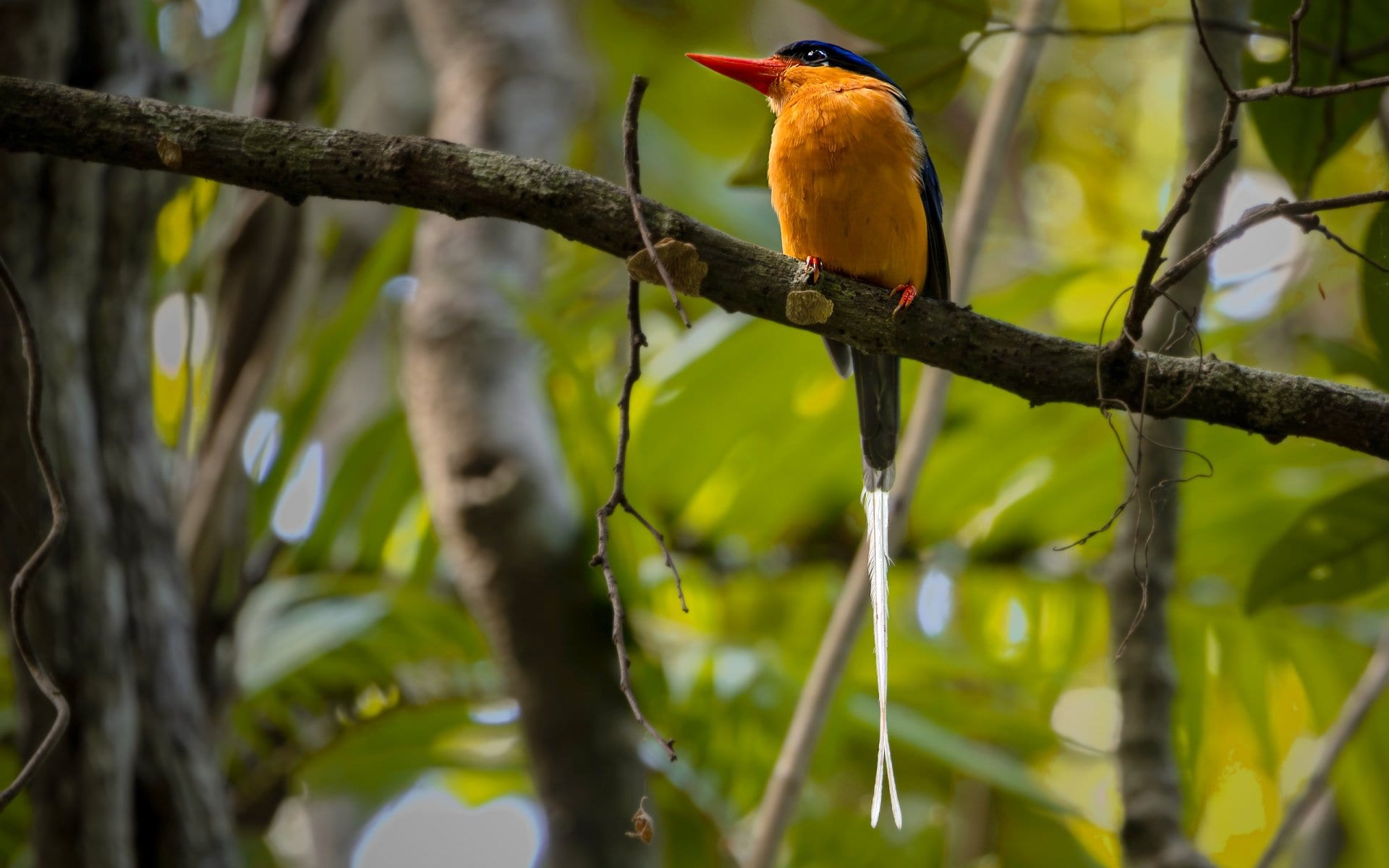
Each November, the Buff-breasted Paradise Kingfisher (Tanysiptera sylvia) arrives in the rainforests of north-east Queensland after crossing from New Guinea. With its red bill, glowing buff underparts and long white tail streamers, it is one of the most striking birds to visit Australia.
It stays only for the breeding season, nesting in termite mounds on the rainforest floor, and heads north again by about April. That short window makes it one of the great summer targets in the Wet Tropics.
Identification
This is a medium-sized kingfisher, about 34 cm long including the tail, and most of that impression comes from two long white central tail feathers. Look for the bright red bill, rich buff to orange underparts, blue-black upperparts with blue on the crown and wings, and a white patch on the lower back that shows when it flies.
Nothing else in Australia has this combination. In dim forest, the white streamers and the slow flick of the tail are often what give it away.
Habitat
It lives in lowland rainforest and isolated patches of hill forest, usually where the understorey is fairly open and active termite mounds are present on the ground.
Behaviour
It usually sits quietly in the middle or lower levels of the forest, watching for prey, then drops to the ground or takes food from the foliage. Pairs defend territories through the breeding season. A calling bird often flicks its tail continuously, which can help you find one sitting still in the shadows.
Voice
The call you are most likely to hear is a repeated, rising ch-kow, ch-kow. There are also softer trills, and it can call even with its mouth closed or food in its bill. Listening is usually the best way to find one, particularly early in the season, when birds are setting up territories.
Diet & Breeding
It eats insects and other invertebrates, along with small lizards and frogs. Breeding starts almost as soon as the birds arrive. The pair digs a nest chamber into an active termite mound on the ground, and the clutch is usually 3 or 4 white eggs. Both parents incubate and feed the young.
Distribution & Seasonality
The species occurs in New Guinea and north-east Australia. Australian breeders arrive in early November and stay until about early April, ranging from the Torres Strait and Cape York Peninsula down the Queensland coast to central Queensland. They spend the rest of the year in New Guinea, and young birds leave up to three weeks after the adults.
Where to See It
In the Wet Tropics, search lowland and foothill rainforest with termite mounds on the ground between November and March. Start early, listen for the rising call, then scan the mid-levels for the white tail.
Please watch from a distance and never approach or disturb a nest mound, and keep exact nest locations to yourself.
See this species with us
The Buff-breasted Paradise Kingfisher is among the species we look for on our guided trips. Half of Australia's bird species live in our region, including the 15 Wet Tropics endemics.
Explore the tour →